
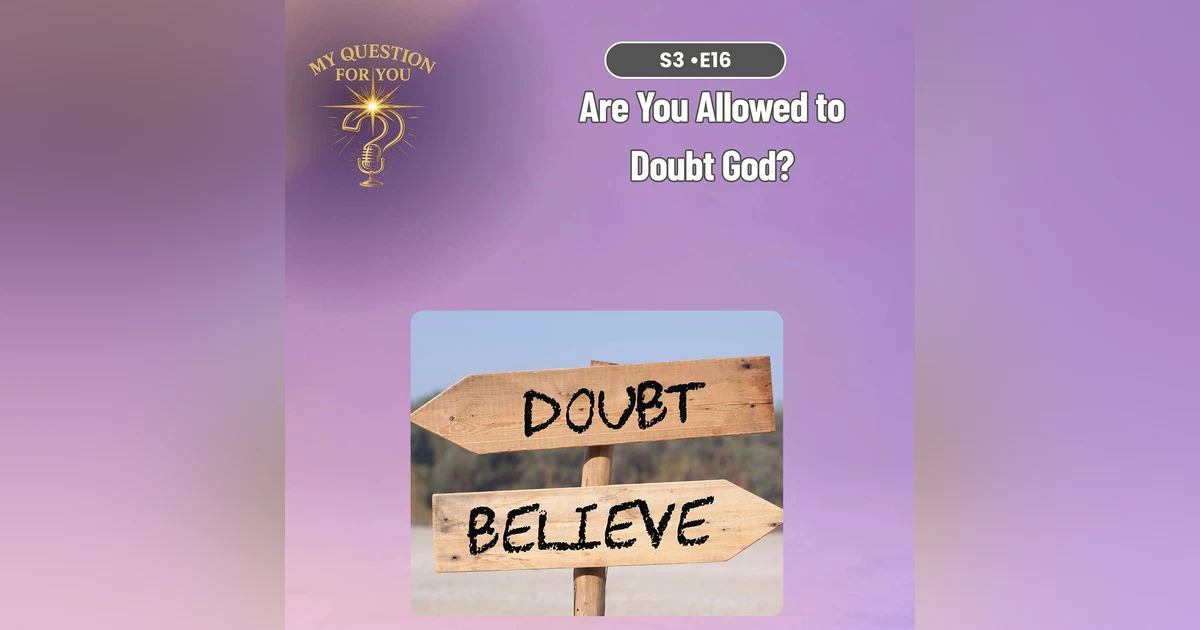
Are You Allowed to Doubt God?


You're the one people call. The steady one. The one everyone else borrows faith from on their worst days.
But lately, there's a question you haven't said out loud. Not to your small group, not in worship, maybe not even fully to yourself: is God actually paying attention to any of this?
In this episode, we sit with a man who knew that exact tension. John the Baptist was the most certain person in Scripture. He's the one who pointed at Jesus in front of a crowd and called him the Lamb of God. But later, sitting in a prison cell, that same John sent his own followers to ask Jesus directly: "Are you the one, or should we expect someone else?"
His doubt didn't disqualify him. It didn't undo what he'd already believed. And it doesn't undo yours either.
This week's question: Are you allowed to doubt God?
In this episode:
- Why the "strong one" often carries the heaviest unspoken doubt
- The real difference between doubt and unbelief, and why that difference matters
- John the Baptist's story in Matthew 11, and what Jesus actually says in response to his doubt
- A verse worth writing down for the next time doubt catches you off guard
- Practical ways to bring your doubt to God instead of hiding it behind a smile
This is part three of our five-part series, What's Behind Your Smile? — five weeks of asking what we're really carrying underneath the version of ourselves everyone else gets to see.
You don't have to pretend you're fine for the One who already knows you're not.
🎧 New episodes every week. Subscribe so you never miss a question.
If this one hit close to home, share it with someone who might need it too.
🔗 Take the next step at myquestionforyou.com — and join the free weekly email, A Quiet Invitation, for a short word of encouragement each week. Or just visit: https://preview.mailerlite.io/forms/1717098/165207819752047949/share
✨ Encouragement for your spirit. Wisdom for your walk.
I want you to stop and picture this. You're standing in worship, hands raised, singing along to a worship song about God's goodness, and somewhere around the second verse, something in you just catches. Because it's been a hard month, and for a second, you're not sure you actually believe the words coming out of your own mouth. So you do what you always do. You keep singing. Because stopping would mean explaining why. And explaining why feels like it would take the whole room down with you. So you finish the song. You say amen at the end of the prayer. Someone asks you how you're doing on the way out, and you say, I'm good, just a little tired. And you drive home with the radio off because, for once, you don't want to hear one more song about how faithful God is. Nobody in that room saw what just happened behind your smile. So here's my question for you today. Are you allowed to doubt God? Hi, I'm Melissa, and this is my question for you. We are in week three of our series that I'm calling What's Behind Your Smile. So for five weeks, we've been asking what we're actually carrying underneath a version of ourselves that everybody else gets to see. If this is your first time here, I want to welcome you and thank you for joining. And just know you don't need to know the first two episodes of this to make sense. But if you've been with me these past few weeks, you already know the question sitting underneath everything we're doing. What's behind your smile? Today, we're naming something a lot of strong believers are carrying and just not saying, not casual doubt, but the kind you'd never bring up to your friends, your family, your pastor, to anyone. Because you're supposed to be the one with all the answers. You know, maybe you turn on the news and it's another war that's been going on so long, people stopped asking why. They stopped paying attention. Or maybe it's even a little closer to home. You know, crime in your own neighborhood starts ticking up, prices at the store making you do math that you'd never had to do before. Just a world that feels less safe and less steady than it did a few years ago. You never used to flint at the headlines. Now you find yourself bracing for them. And it's not just the world out there. It's the diagnosis you've prayed over more times than you can count, and the update this week wasn't any different. Maybe it's a marriage that's quietly coming apart in the same house for a year, and nobody outside those four walls has any idea. All of it presses on the same bruise, the same pain. If God sees all this, the wars, the violence, the bills, the diagnosis, why does it feel like nothing's moving? But you don't get to sit with that because it's Sunday and you're leading worship this week, or it's Tuesday and somebody in your prayer group needs you to pray over them right now. Or maybe it's just a random Wednesday and somebody sends you a text and says, Can you believe with me on this? Can you join me in prayer? I know if anyone's faith can carry it, it's yours. You're getting it from all angles. But still, you smile. You sing along to a worship song about God's goodness, you keep praying out loud for everyone else's breakthrough. That's the smile this whole series keeps circling back to. Not a happy one, but a held together one. And underneath it, a quieter question just keeps circling. Is this actually getting through? Is someone even listening on the other end of this? That's a hard thing to admit when you're the one everybody else leans on. Because if the strong one starts wondering whether prayer even works, what does that make everyone who's been leaning on you think? What does that look like for them? So you don't say it. You just keep smiling and singing and praying and quietly wondering alone, is God even listening? Can he even hear? Because nothing seems to be changing. There's a man in scripture who carried this exact weight, and honestly, no one saw it coming from him either. So let's turn to scripture. We are in the book of Matthew, Matthew 11. His name is John. We all know him, John the Baptist. And if anybody in the Bible had earned the right to never doubt again, it was him. So quick backstory because this part matters. John lived out in the wilderness. Camel's hair, locusts, wild honey, whole nine yards. He preached with a boldness that pulled entire crowds out of the cities just to hear him. He wasn't soft about it either. He confronted people directly about their sin, no matter who they were. He even confronted King Herod publicly about an unlawful marriage. That's actually what got him thrown into prison in the first place. But before any of that, John did something no one else in scripture ever got to do. He baptized Jesus. And when he saw Jesus walking toward him, John's the one who said it out loud in front of everyone. He said, Look, the Lamb of God who takes away the sin of the world. That's in John chapter 1, verse 29. Of everyone alive at that moment, John was the most certain person on earth. He'd seen it. He'd said it, no hesitation. Now, fast forward, John's sitting in a prison cell waiting to find out if he's going to be executed. And from that cell, he starts hearing reports about everything Jesus is doing out in the world. And instead of resting in the certainty he used to have, John sends his own followers to go ask Jesus something directly. He says, Are you the one who is to come? Or should we expect someone else? That's in Matthew chapter 11, verse 3. I want you to think about that again, because this is the same man who pointed at Jesus in front of a crowd and called him the Lamb of God. And now, after all the suffering and being afraid, being in prison, facing execution, he's asking if he got it wrong. I need you to sit with how big that moment actually is. John wasn't just a casual follower. He gave up everything, his comfort, his safety, and eventually his freedom for what he believed. And even he, in his lowest moment, needed to ask the question out loud instead of just performing certainty for everyone who was watching him. And look at what Jesus doesn't do. He doesn't rebuke him, he doesn't send back a message shaming John for doubting. He tells John's followers this go back and report to John what you hear and see. The blind receive sight, the lame walk, those with leprosy are cleansed, the deaf hear, the dead are raised, and the good news is proclaimed to the poor. And then gently he adds Blessed is anyone who does not stumble on account of me. It's not a correction, it's an invitation to keep looking. And later in that same chapter, later in Matthew chapter 11, Jesus says something that should genuinely stop you in your tracks. He says, Among those born of women, there has not risen anyone greater than John the Baptist. Set about the same man who just sent a message from prison asking if he'd gotten it all wrong. His doubt didn't disqualify him. It didn't erase what he'd already believed, what he'd already given up. Doubt and faith were sitting in the same jail cell that day, and one didn't have to cancel out the other. So let's pause here for a second because I know for some of you, even saying the word doubt out loud feels risky. Like admitting it might undo everything you've built your whole life on. So let's just name the difference plainly. Doubt and unbelief are not the same thing. Unbelief walks away from the conversation completely. It stops praying, stops asking, stops showing up because it's already decided there's no one on the other end worth talking to. Doubt stays in the room. It keeps asking, even scared, even uncertain, unsure, because some part of it still expects an answer. Look at what John actually did. He didn't quietly decide Jesus wasn't who he thought and walk away disillusioned. He sent people in person to go and ask directly. That's not a man who gave up. That's a man who still believed enough to demand an honest answer. David does this constantly all through the Psalms. He asks, How long, Lord, will you forget me forever? He accuses God of hiding. He asks God why he feels so far away in his worst moments. And scripture doesn't edit any of that out for being too honest. It keeps it word for word. As a prayer, we are invited to pray right along with him. That's the real difference. Unbelief closes the door and leaves. Doubt keeps knocking on that door, whether it's confused, exhausted, maybe even a little angry, but still standing there, still expecting God to open it. And a God who's patient enough to answer knocking doesn't turn away from someone who's still asking. So if you've been scared that your questions mean you've lost your faith, I want you to hear this clearly. The fact that you're still asking is the proof that you haven't. You haven't lost your faith at all. So if you take one thing from this episode and actually write it down, let it be this. Something to reach for just the next time doubt shows up, and we all know it will. Honestly, no cleanup. He says, I do believe. Help me overcome my unbelief. That's in Mark chapter 9, verse 24. That's not a contradiction. That might be the most honest prayer in the entire Bible. Belief and doubt in the same breath to the same God. Write that one down somewhere that you'll actually see it and you can find it and refer to it often. Because next time you're the one everyone's leaning on, and the question rises anyway, you won't have to perform your way past it. You'll already have those words in your heart, in your spirit to help you get through and push past that moment. So let me bring this back to you. Maybe you are the one people call, the steady one, the strong one, the one whose faith isn't supposed to wobble because everyone else is borrowing strength from you. And maybe underneath all of that, you've been quietly asking, Where are you in all this pain, Lord? Are my prayers even getting through? What does it say about me if I'm just not sure anymore? So here's my question for you What are you afraid if your doubt says about your faith? Because here's the truth It doesn't say you failed. It doesn't mean you were never really strong to begin with. It might just mean you've been performing certainty for so long you forgot you were even allowed to ask the question honestly. You don't have to keep smiling through this. The one that says, I'm believing for it, while you're quietly wondering if anyone is believing for you. You don't have to pretend you're fine for the one who already knows you're not. And yeah, that includes pretending your faith never wavers. John asked his question from a prison cell, and he was still called the greatest. Your question doesn't disqualify you either. It might just be the most honest prayer you've prayed in a long, long time. So practically, what does this actually look like for someone who's used to being the strong one? It's not stepping back from praying for people. It's not making some announcement before worship starts that you're not okay and you need help. It's smaller than that. And it's more honest than that. First, I want you to say the real thing to God before you say the practiced thing. What does that look like? The next time you sit down to pray, before you start running down everybody else's list, tell God where you actually are. Not the version you say in front of your group or the made-up prayer or the one that feels like what you're supposed to say, but the real one. God, I don't understand why this is happening. I'm not sure my prayers are landing anywhere today, but I'm still here and I'm still asking. That's not weak praying. That might be the most honest prayer you do all week. So I want you to really think about it and really bring it to God openly and honestly. Second, let one person see the version of you that doesn't have it all together. We've talked about this before, and I keep coming back to it because we know that community is so important. There has to be that one person that you feel you can be open with and transparent with, that you can reach out to that can reciprocate your emotion and your feeling. I I really this means so much to me, and I challenge you to think about who that person might be in your life. It's not everyone. You don't owe your doubt to the entire church congregation or your family members, or everyone doesn't need to see that. But is there one person, just one, who could handle hearing? God, honestly, I've been struggling with this, and I didn't want to say it out loud until now. Who's the person on the other side of that conversation? Being known by one trusted person does something that performing strength for a crowd never will. And then the third thing, keep showing up before the doubt is fixed, before it's resolved. John didn't wait for his answer before he kept functioning as who God made him to be. You just need the willingness to show up honestly instead of performing a certainty that you don't really feel. Here's what I really want you to hear. Bringing your doubt to God isn't the failure. Hiding it and calling that faith, that's the version that actually wears you out. So if you have your journal nearby, I want you to write this down. What question about God have I been afraid to ask out loud, even in prayer? Don't try to answer it all today. I don't want you to give it too much thought. Just write it down and come back to it often. You just need to stop performing your way past it and face it head on. Verbally doubting and questioning Jesus. And yet it didn't cost him his place in the story. You're allowed to ask your questions too. So the next time you catch yourself smiling to cover what's really underneath, let that be your cue. Not to try to fix everything then and figure it all out, but just to bring it to God instead of burying it. Until next time, keep asking, keep listening, and remember, you can have it all together on the outside and still be whispering, where are you underneath it? Both can be true, and God's near either way. You can sign up at myquestionforyu dot com, bringing you encouragement for your spirit and wisdom for your walk.