
Are You Dressed for This?
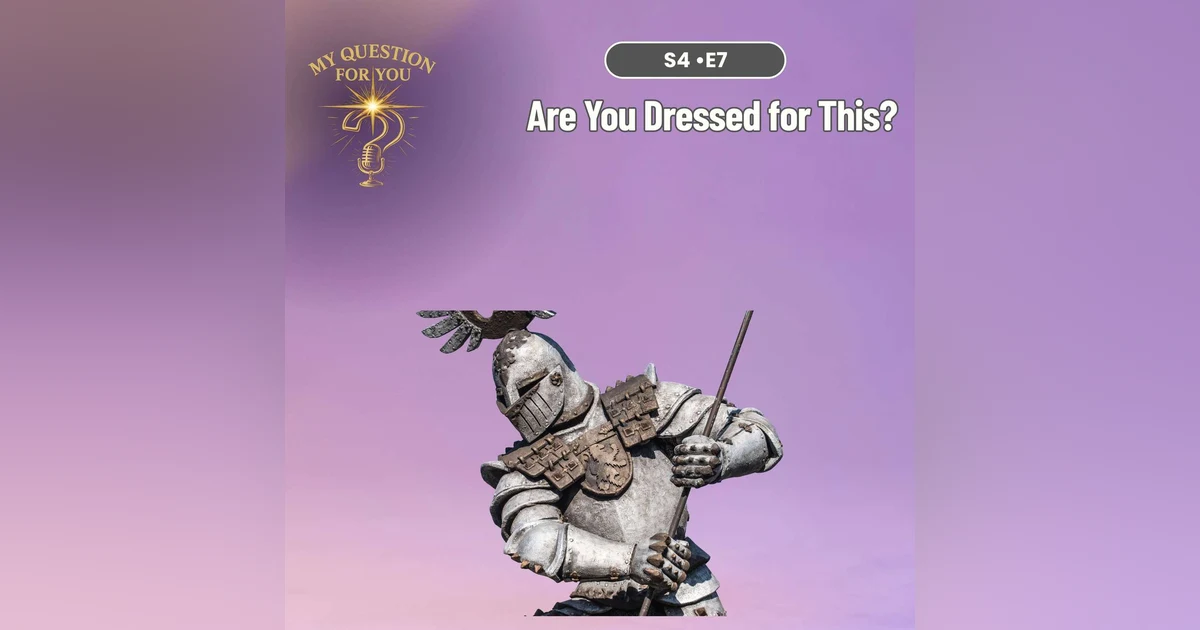


Season 4 of My Question for You: Wisdom for Your Walk continues with a brand-new series: SUITED UP.
In our last series, Behind Enemy Lines, we learned to recognize the enemy and some of the ways he works. Now we’re shifting the focus to what God has given us to stand against him.
And we’re starting with a familiar passage: the armor of God in Ephesians 6.
You may know the armor by heart. You may even be able to name every piece without opening your Bible. But knowing the armor isn’t the same thing as wearing it.
Throughout SUITED UP, we’re going beyond what each piece represents to explore what it actually looks like to live in what God has given us when life gets real.
And it starts with one question:
Are you dressed for this?
🎧 Listen now and consider what you’re actually reaching for when fear, doubt, temptation or uncertainty shows up.
Scripture: Ephesians 6:10–18; James 1:22–25
🎧 New episodes every week. Subscribe so you never miss a question.
If this one hit close to home, share it with someone who might need it too.
🔗 Take the next step at myquestionforyou.com — and join the free weekly email, A Quiet Invitation, for a short word of encouragement each week. Or just visit: https://preview.mailerlite.io/forms/1717098/165207819752047949/share
✨ Encouragement for your spirit. Wisdom for your walk.
If I asked you to name the armor of God, how many pieces could you get? Go ahead. I'll wait, no pressure. If you've been around church for a while, you probably know most of them. You may have learned them in Sunday school or taught them to your own children, or maybe you read about them in a Bible study. There's the belt of truth, the breastplate of righteousness, shoes connected to the gospel of peace, there's the shield of faith, the helmet of salvation, and the sword of the spirit. We all know the picture. But lately, I've been wondering if that's part of the problem. Not that we know it, of course we should know scripture. I'm wondering if some passages become so familiar that we stop asking what they actually require of us. We recognize the words. We can finish the sentence, we hear armor of God and immediately picture the Roman soldier we've seen a hundred times. But Paul never told us to name the armor. He told us to put it on. And those are two very different things. Hey, I'm Melissa, and this is my question for you. We just finished our series, Behind Enemy Lines, where we spent six weeks talking about spiritual warfare and learning to recognize some of the ways the enemy works. And when we finished that series, I told you we weren't done with this conversation. Because once you recognize that there's a battle, the next question becomes pretty obvious. Okay, so what do I do? Ephesians 6 gives us an answer many of us have heard before. But for this series, which I'm calling suited up, I want us to hear it differently. I don't want us to spend the next several weeks simply identifying pieces of armor. I want to know whether we're actually wearing them. So here's my question for you. Are you dressed for this? I can tell you that the shield represents faith. Great. But what does that tell me to do at two in the morning when I'm lying in bed worrying about something I can't control? I know there's a belt of truth, but what happens when something I'm feeling is so strong that it seems more believable than what God has said? And I know there's a sword of the Spirit, which Paul tells us is the word of God. But what good is a sword I don't know how to use? That's where I think this passage starts getting interesting again, because Paul wasn't writing Ephesians so Christians 2,000 years later could correctly label a picture of a Roman soldier. He was writing to believers, real people trying to follow Jesus in a real world where following him wasn't always easy. And by the time Paul gets to the end of this letter, he has spent a lot of time talking about what it means to belong to Christ and then live like it. So he says, finally, be strong in the Lord and in his mighty power. And right after that, he says, put on the full armor of God. There's an action there. Put it on, which tells me it is possible to know that something is available to you and still not be using it. Okay, let's think about it this way, in a much less spiritual way. You could check the weather before you leave home and see that it's going to be cold. Now, you own a coat, a good coat, you know exactly where to find it. You could probably describe it with your eyes closed in great detail. But if you leave it hanging in the closet and walk outside without it, you're still going to be cold. So knowing you own it doesn't help you much if you aren't wearing it. And I wonder if we sometimes do something similar with the things God has given us. We know truth. We believe faith matters. We know Jesus gives us peace. We believe scripture is powerful, and we know that we belong to God. But then life happens. And the question becomes whether any of that moves from something we know into something we actually use. That's where this series is going. Because I don't think Paul is inviting us to admire the armor. I think he expects us to live in the armor. Now, if this scripture is new to you, let me give you a little bit of context. Paul wrote the book of Ephesians as a letter to believers in and around Ephesus. And near the end of the letter, he begins talking very directly about spiritual opposition. He tells them that their struggle is not ultimately against flesh and blood. There is a spiritual reality to the life they're living. And because of that, they need to be prepared to stand. Then Paul uses the picture of armor. He talks about the truth like a belt, righteousness like a breastplate, readiness that comes from the gospel of peace like shoes. He talks about faith becomes a shield, salvation, a helmet, and the word of God a sword. We're gonna slow down and look at every one of these. But before we do, I think we need to notice what Paul says more than once. In verse uh 11, he says, put on the full armor of God. Then in verse 13, he says, put on the full armor of God. Paul repeats himself, which as somebody who spends a lot of time editing herself so she doesn't repeat herself, that got my attention. He wants them to do something with what God has provided. And I think that's important because sometimes we talk about the armor of God as though it's a collection of spiritual concepts, truth, faith, peace, salvation, righteousness, scripture. All of these things, all of these things are important, but Paul puts them in the language of something you wear and something you use. That makes this incredibly practical. There's another part of this passage that I think we can miss because we're so familiar with the phrase. Paul calls it the armor of God, God's armor. That means when Paul tells you to stand, he isn't telling you to walk into a spiritual battle and see how tough you are. Actually, before he says anything about the armor, he says, be strong in the Lord and in his mighty power. That's where this starts with God's strength. And I think that changes the tone of this entire conversation. Because if I hear spiritual warfare and immediately think I have to become stronger, tougher, or more spiritually impressive, I'm already carrying something Paul never gave me. This isn't a test to see how strong I can become. Thank God for that. The strength comes from God. The armor comes from God. My responsibility is to learn how to live in what he has provided. And suddenly this passage feels less like God saying, you better get yourself ready. It sounds more like I know what you're walking into, and I have already provided what you need to stand in it. And that feels different. So now I want to bring this out of Ephesians 6 and into our ordinary life. Because most spiritual battles don't announce themselves. You don't wake up to dramatic music playing in the background while a voice is saying, Today you will enter into spiritual warfare. You woke up on a Tuesday, you have emails waiting, somebody says something that gets under your skin, a thought enters your mind, it hangs around longer than it should. Something you've been praying about still hasn't changed, or maybe you hear news that you weren't expecting, and you get tired. Life can be overwhelming. And somewhere in the middle of your ordinary day, you realize something is happening inside of you. Your peace is gone, and you're questioning something you felt you were so sure about yesterday. You're entertaining a thought you know isn't taking you anywhere good. That's where I want this series to live. Not on the picture of the soldier, but right here. In the moment when what you say you believe has to become something you actually live by. Because maybe the question in those moments isn't always, why is this happening to me? Maybe sometimes the question is, what did I walk into this without using? Did I know the truth, but let the lie run the conversation? Did I have access to peace but allow the chaos around me to set my tone? Or maybe you want to, you're wondering, did I say I trusted God, but I lowered the shield the minute something came at me? That doesn't mean every hard day is happening because we forgot to put on spiritual armor. Life is still life. But it does mean God has given us something for the life we're walking through. And I want us to know how to use it. Jesus talks about something similar when he tells believers not to merely listen to the word and then walk away without doing what it says. He compares it to someone looking at themselves in a mirror and then immediately forgetting what they look like. I think that principle fits here in this context. There's a difference between being familiar with scripture and allowing scripture to shape how we respond. And familiarity can fool us because sometimes we've heard something so many times that it feels like we've mastered it. But recognizing a verse isn't the same as living it. Knowing the belt represents truth doesn't automatically mean truth is holding me steady. Knowing the shield represents faith doesn't automatically mean faith is what I reach for when something comes flying at me. And knowing the sword represents the word of God doesn't mean I know how to use scripture wisely when I need it. So over the next several weeks, that's what I want us to figure out together. What does this armor look like when it leaves the pages of our Bible? There's something really encouraging to me about the fact that this passage exists at all. God knows we need this. Think about that. He knows there will be things that challenge what we believe. He knows our minds need protection. He knows there will be moments when faith feels like something we have to deliberately do. And he knows we need peace. We need peace underneath our feet, and we need truth holding things together. We need his word. So he gave us what we need. That doesn't mean we'll never struggle. The armor isn't evidence that the battle disappears. It's evidence that God knew there would be a battle and he prepared us to stand in it. Which takes me back to where we ended the last series behind enemy lines. We learn to recognize the enemy so we wouldn't spend our lives looking for him, blaming him, and staring at him. Now we turn our attention toward what God has given us. And there's a shift there. This series isn't really about becoming more impressed with spiritual warfare. I want us to become more confident in the God who has equipped us for it. So let me ask you again. Are you dressed for this? And I don't mean, can you name all six pieces of armor? I mean when something challenges you this week, what are you actually reaching for? Because there may be a difference between the armor you know and the armor you wear. That's what I want you to pay attention to. When your thoughts start moving in a direction you know isn't good, notice what you what you do next. When fear shows up, notice what you reach for. Or when someone disrupts your peace, I want you to pay attention to what gets control of you. When you hear something that sounds true, ask yourself what you're measuring it against. No pressure to try to fix it all this week. I just want you to notice, because before you learn how each piece works, it might help to discover where we've been walking around exposed without even realizing it. So this week, when you feel yourself getting pulled off course, pause long enough to ask, what has God already given me for this situation? That question moves our attention away from trying to manufacture enough strength to handle everything ourselves. And it brings us back to the beginning of Paul's instruction: be strong in the Lord and in his mighty power. The battle may be real, but you did not walk into it empty-handed. And maybe this week, you don't need to become stronger. Maybe you need to become more familiar with what God has already given you. Next week, we're going to start with the first piece Paul names, the belt of truth. And I have to admit, this is one I've probably moved past too quickly before. I mean, truth is truth, right? We know the truth. Put on the belt, believe what God says, okay, moving on. Except Paul could have connected truth to any piece of armor, and he chose the belt. So I want to know why. What did that belt actually do? Why would truth be connected to a belt? And maybe the bigger question for us is this what happens when the thing that's supposed to hold everything together starts to get a little loose? That's where we're going next. So, friends, are you dressed for this? You may know the armor of God by heart. You may be able to name every piece without opening your Bible. But this week, I want us to move beyond knowing what the armor is and start paying attention to whether we're actually living in it. Because God didn't give us truth, righteousness, peace, faith, salvation, and his word so we could simply recognize them. He gave them to us because he knows what we're walking into. Until next time, I hope you'll keep asking, keep listening, and remember, knowing what God has given you is one thing. Learning to live in it is where the armor becomes real. You can sign up at myquestion for you.com, bringing you encouragement for your spirit and wisdom for your walk.