
Are You Still Standing?
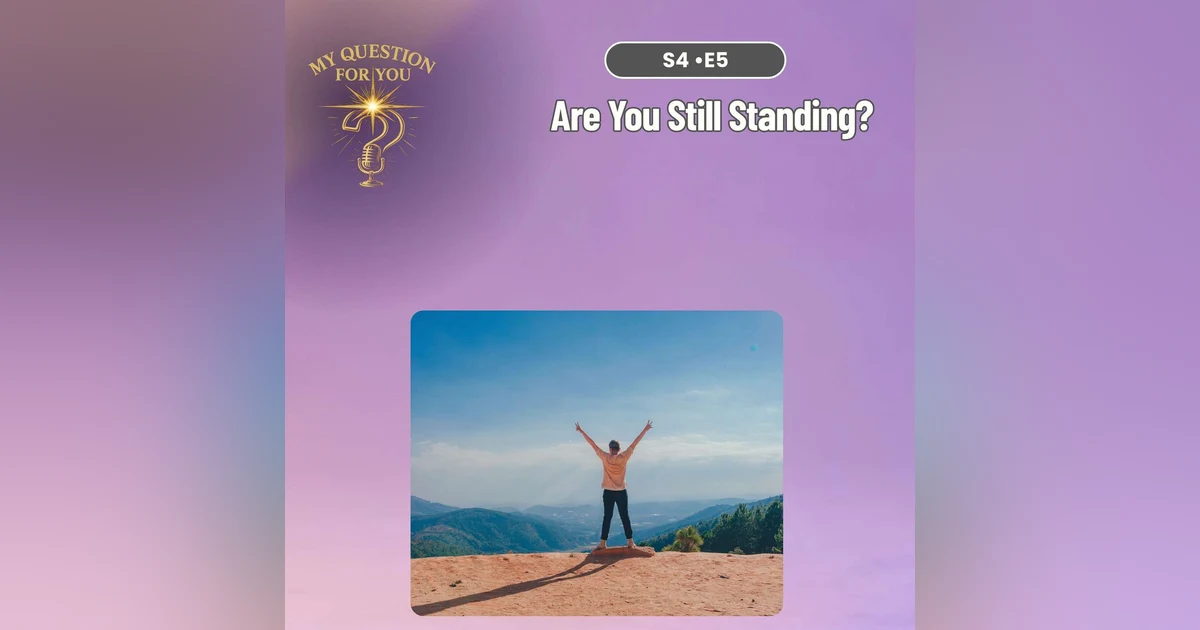


What if the fact that you’re still in the battle doesn’t mean you’re losing?
Sometimes we’re so focused on wanting the struggle to disappear that we miss what God has already strengthened in us.
In Episode 5 of Behind Enemy Lines, we return to Ephesians 6 and take a closer look at one simple instruction Paul repeats: stand. We’ll talk about the difference between standing and striving, why resistance doesn’t always mean the struggle stops, and how spiritual growth can show up in the way something no longer moves you like it used to.
Because victory isn’t always the moment the battle disappears.
Sometimes it’s realizing…
you’re still standing.
🎧 New episodes every week. Subscribe so you never miss a question.
If this one hit close to home, share it with someone who might need it too.
🔗 Take the next step at myquestionforyou.com — and join the free weekly email, A Quiet Invitation, for a short word of encouragement each week. Or just visit: https://preview.mailerlite.io/forms/1717098/165207819752047949/share
✨ Encouragement for your spirit. Wisdom for your walk.
Quick question. What if you're doing better than you think you are? Seriously, I want you to think about something you've been dealing with for a while, something you've prayed about, wrestled with, tried to understand, and probably wished God would just take it away. But it's still here. And because it's still here, you may have assumed you're losing. But I'm not so sure because what if the measure of victory isn't always whether the battle went away? What if sometimes the evidence that God is doing something in you is that the thing that used to knock you down doesn't anymore. You're still dealing with it, you still wish you weren't, but somehow you're still standing. Hey, I'm Melissa, and this is my question for you. We're in part five of Behind Enemy Lines, and I think we've reached an important turn in this series. We started by asking who our enemy really is. Since then, we've looked at deception, accusation, and temptation, not because we want to become preoccupied with the enemy, but because Scripture tells us to be aware of how he operates. So eventually, recognizing the strategy has to lead somewhere. Once we recognize the lie, what do I do? Once we realize that accusation is trying to turn my failure into a verdict, then what? And once I recognize that I'm vulnerable and the thing in front of me may not actually satisfy what I'm hungry for, what comes next? Paul gives us an answer in Ephesians six, and it may be much less dramatic than we expect. One word, stand. So here's my question for you. Are you still standing? Because maybe you've been so focused on the fact that you're still in a battle that you haven't noticed you're not where you used to be. Paul tells believers that our struggle is not against flesh and blood, which helped us establish right from the beginning that the person getting on your last nerve is not the enemy. That was important to know. But if we keep reading, Paul doesn't just tell us who we're fighting, he tells us what to do. In verse 13, he says, Therefore, put on the full armor of God, so that when the day of evil comes, you may be able to stand your ground. And then comes this and after you have done everything to stand, that phrase has been sitting with me. After you've done everything, stand. I think part of the reason it gets me is because standing doesn't sound particularly impressive. I want a verb with a little more action like advance, conquer, overcome. Something that sounds like we're making progress. But Paul says stand. And he doesn't just say it once. Earlier, he tells us to put on the armor of God so that we can stand against the enemy's schemes. Then he tells us to stand our ground. After we've done everything, stand. And the next verse begins, stand firm then. Clearly, Paul wants us to get this. He wants us to understand the importance of standing and being fixed and staying firm and steady. There are moments when faithfulness isn't about advancing another ten feet. It's about refusing to give up the ground you're already standing on. And I wonder if some of us have been calling that failure because we expected victory to look a little different. I think there's an assumption we can carry into our faith that if we're doing everything right, eventually the struggle should disappear. We prayed, we read scripture, we tried to make the right decision, we asked God for help. So why am I still dealing with this? Why am I still having that thought? Why does that temptation still show up? And why am I having to remind myself of something I thought I had already learned? I don't know about you, but I would love for spiritual growth to mean that once God teaches me something, I never have to deal with it again. Lesson learned, check the box, moving on. That has not been my experience though, because sometimes growth looks like encountering something familiar and responding differently. A situation may look similar, the thought may still show up, you may even feel that old pull for a moment, but this time it doesn't carry you as far. And that matters because resistance doesn't always mean the attack stops. Sometimes it means you stop moving with it. Now, I want to make something clear. Standing is not passive. When Paul says stand, he isn't telling believers to cross their arms and wait for everything to work itself out. There's a reason he immediately starts talking about armor. He says, Stand firm then, with the belt of truth buckled around your waist and the breastplate of righteousness in place. Then he talks about being ready with the gospel of peace, taking up the shield of faith, putting on the helmet of salvation, and taking the sword of the spirit, which is the word of God. If you grew up in church, you may have colored a picture of this at some point in Sunday school. I know somebody listening remembers the little Roman soldier on the Sunday school workshop worksheet, right? We've all seen that. We've all colored it. But at the time as children, we didn't really know or understand what it meant. Even as an adult reading this, and I know most of us are familiar with the armor of God and the book of Ephesians. And there's nothing wrong with learning new pieces. And I think, or rather, I hope that's what we're doing here, right? Looking at something that we've all seen, even as far back and as early as childhood, coloring in Sunday school, to reading Ephesians and knowing about the armor of God, to learning something a little different or looking at it in a different way. I think we can become so focused on matching the belt of truth and the helmet to salvation that we miss the bigger picture sometimes. So let's look at what Paul is telling them to stand in. He's saying stand in truth, righteousness, peace, faith, salvation, and the word of God. These aren't things you suddenly have to invent because life got hard. God has already given you something to stand in. And that changes the picture. Because spiritual resistance isn't me frantically trying to become powerful enough to defeat whatever is coming against me. It's learning to remain anchored in what God has already said and provided. I think back over where we've been in this series over the past four weeks that we've been behind enemy lines. We talked about deception. Once you recognize a lie, you don't have to spend the next three weeks arguing with it. You can stand in truth. Last week we talked about temptation and those moments when a real hunger can make the wrong thing look reasonable. Recognizing the hunger doesn't guarantee you'll never feel it again, but it gives you the opportunity to make a different choice when you do. And when accusation brings up something you've already confessed and tries to convince you that your failure gets the final word, you don't have to reopen the entire case. You can stand in what God has already said. I think we wear ourselves out sometimes because we believe every thought deserves an argument. But it doesn't. Every accusation doesn't require a defense. Every temptation doesn't require a negotiation. Sometimes the answer is simply, I know what God said. And then you stay there in that moment. That sounds simple, but it isn't always easy. And there's a difference between the two. I think this is where we need to talk about the difference between standing and striving. Because I know how easy it is to confuse the two. Striving feels productive. If something isn't changing, I want to figure out what else I need to do. How can I fix it? How can I get some movement, create traction in this thing? Maybe I need to pray harder, find another scripture, listen to another sermon, or come up with another plan. And none of those things are necessarily bad. But there comes a point when all of our activity can become an attempt to manufacture something that God never asked us to manufacture. Standing requires a different kind of trust. Standing says, I've done what God asked me to do, and now I'm going to remain faithful here even if I don't see the outcome yet. That can be hard because getting out sounds a whole lot better than standing. If I'm in a difficult season, I want God to change the season. If there's opposition, I want him to remove it. If something keeps pressing against me, I want God to make it stop. And of course, we can ask him for those things. But what if his work in this moment isn't only about changing what's happening around you? What if he's also changing what can move you? That's a different kind of victory. Think about how you responded to something now compared to how you would have responded to it a year ago. There may have been a time when one person's opinion could ruin your entire day. One unexpected bill could send you straight into a panic. A mistake could turn into three days of beating yourself up and agonizing over that mistake, replaying it over and over again. Or maybe a delay would make you question whether God had forgotten you completely. And that's okay. Standing doesn't mean you become emotionless. It means the emotion doesn't automatically determine your direction. And that's why I'm beginning to think we may underestimate what God is doing in us simply because the circumstances haven't changed yet. We keep looking around for proof that the battle is over. God may be developing something in us that allows us to remain steady while it's still happening. And if that's true, then maybe the question isn't only, God, when are you going to change this? There may be another question worth asking. Maybe we need to ask, God, what are you making steadier in me while I'm here? Because there's a version of you that may have collapsed under something you're currently carrying. Jesus gives us another picture of this in Matthew chapter 7. At the end of the Sermon on the Mount, he asks about two people who build houses. One builds on rock, the other builds on sand. And then the weather comes. Rain falls, water rises, wind blows against the houses, and something about that story is easy to overlook. Both houses get hit by the storm. Jesus doesn't say the person who listened to him and put his words into practice got perfect weather. The storm came to that house too. The difference was what happened when it came. One house fell, the other remained standing because it had been built on rock. That completely changes the way I hear Jesus' promise. Following him doesn't mean nothing will ever hit your life. It means you're building on something that can hold you when it does. And maybe that's why standing matters so much. Sometimes you have to look at the foundation. James chapter 4 gives us another instruction about resistance that I think belongs in this conversation. In verse 7, it says, Submit yourselves then to God. Resist the devil, and he will flee from you. There's an order there that I don't want us to rush past. Before James says resist, he says, submit to God. I think that matters because resistance can sound like it's all about focusing on what we're fighting. Scripture turns our attention somewhere else first. It turns us toward God. It says submit to him. Come under his authority, trust what he says, and let him determine where you stand. And from there, resist whatever tries to move you away from it. That keeps spiritual warfare in its proper place. My life isn't supposed to revolve around watching the enemy. My life revolves around following God. And when something tries to pull me away from him, I recognize it and resist it. There's a huge difference between those two ways of living. One keeps me looking over my shoulder, the other keeps me looking toward God. So what does it look like on an ordinary Tuesday? Probably a lot less dramatic, maybe than I'm making it sound or than we imagine. Resistance may be deciding you're not going to rehearse the same fear for another hour because you already know where it takes you. It may be refusing to let one bad moment become a statement about your entire life. There will be times when standing means obeying God without the reassurance that everything is going to turn out exactly the way you want. And sometimes resistance is simply getting up tomorrow and doing the next faithful thing. No dramatic music, no big spiritual moment, just I'm still here. I still trust God. I'm going to keep going. That counts. Actually, I think it counts more than we realize because we tend to celebrate breakthrough. And we should. We all are striving for great breakthrough. And when we reach it, that's worth celebration. But there is something deeply faithful about remaining planted when breakthrough hasn't come yet. And this is where I want to come back to the question I asked at the beginning. What if you're doing better than you think you are? Maybe you've been measuring yourself by how tired you feel, or by how many times you had to remind yourself of the same truth. You thought you'd be past this by now. But look at you. You're still praying, you're still asking God questions, still trying to obey Him. You got knocked off balance, but you came back to what you know is true. You felt the temptation, and this time you recognized what was happening before it took you where it used to. Something reminded you of your failure, and instead of letting it become your identity, you remembered who gets to decide the verdict. That's not nothing. That's what this entire series has been preparing us for. We're learning to recognize what tries to move us so we become better at staying where God has planted us. Maybe you aren't losing. Maybe you're learning how to stand. So this week, I want you to think about one place in your life where you've been frustrated because something feels like a battle, but still feels like you're going through the same thing. Instead of immediately asking why it hasn't gone away, look at what has changed in you. How do you respond now? What do you recognize sooner? Where are you recovering faster than you used to a year ago, six months ago, a week ago, at the start of this series? What truth are you able to come back to that you didn't know how to come back to before? Growth isn't always loud enough for us to notice while it's happening. Sometimes you only recognize it when you look back and realize that used to take me out. That used to send me spiraling or get me twisted up for days. And somehow I'm still here. That doesn't mean the struggle doesn't matter. And it doesn't mean you aren't tired. It simply means we shouldn't overlook what God may already be strengthening in us because we're waiting for Him to change something around us. So are you still standing? If the answer is yes, even if it's a tired yes, don't dismiss that. Ephesians 6 doesn't tell us that faithfulness means we'll never have anything come against us. It tells us to put on what God has provided and stand. Stand in truth when the lie comes back. Stand in faith when you don't know how the story ends. Stand in what God has said when your circumstances are telling you something different. And after you have done everything, stand. Because maybe victory isn't always the moment the battle disappears. Sometimes victory is realizing it doesn't move you like it used to. Until next time, please keep asking, keep listening, and remember, if you're still standing, don't overlook how far God has already brought you. You can sign up at myquestion for you dot com, bringing you encouragement for your spirit and wisdom for your walk.