
Is Anyone Actually Fine?
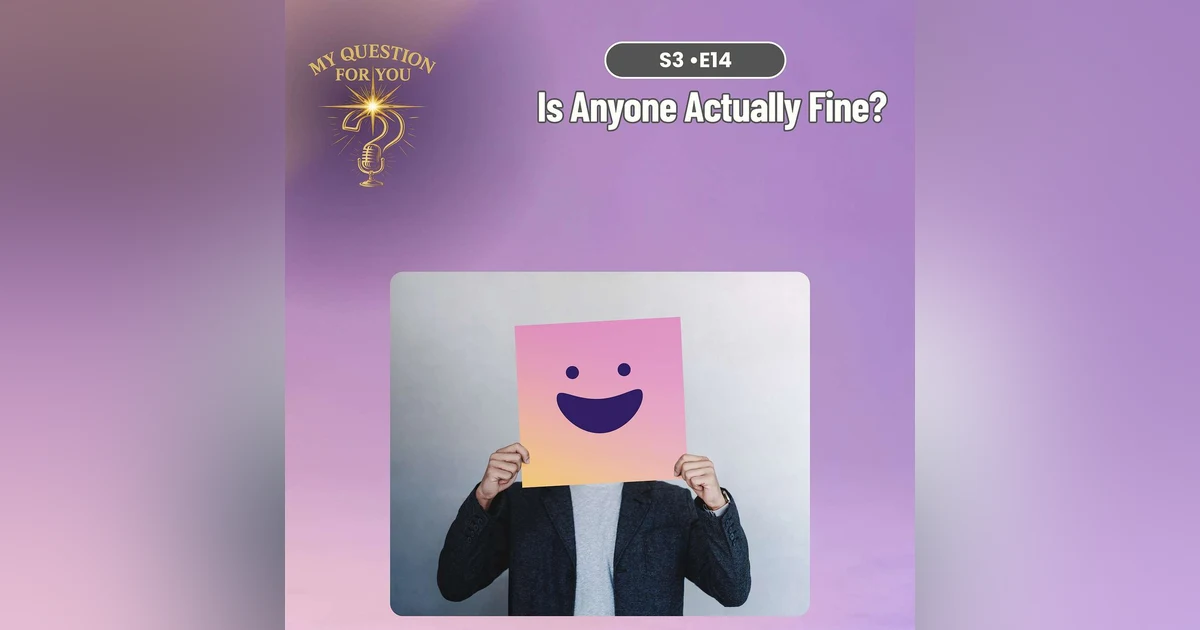


Is anyone actually fine? Or have we all just gotten really good at saying it?
Welcome to a brand new series: What's Behind Your Smile? Over the next five episodes, we're taking an honest look at what people are quietly carrying behind the version of themselves the world gets to see.
In this opener, Melissa talks about the reflex answer we give without even checking if it's true, why "fine" has become the price of admission into a normal conversation, and what 1 Samuel 16:7 has to say about a God who was never fooled by the outward appearance in the first place. Because while people look at what's on the surface, God has always been looking at the heart.
This episode is for anyone who's tired of managing how they come across — including with God.
"You don't have to pretend you're fine for the One who already knows you're not."
If this one speaks to you, share it with someone who might need the reminder today.
🔗 Take the next step at myquestionforyou.com — and join the free weekly email, A Quiet Invitation, for a short word of encouragement each week. Or just visit: https://preview.mailerlite.io/forms/1717098/165207819752047949/share
✨ Encouragement for your spirit. Wisdom for your walk.
Okay, so not too long ago, I asked someone how they were doing. Just in passing, and they said fine, just busy. You know how it is. And here's the thing, I actually knew some of what they were carrying. Real stuff, hard stuff, and they still said, Fine. And you know what I did? I said, good, good, and I kept walking. I've been thinking about that a lot lately. Not because it was the huge moment that happened, because it wasn't. It was just a normal, everyday exchange. But I keep thinking about how easily we both went along with it. Like we'd both agreed without ever saying it, that fine was the answer we were going to use, whether or not it was true. And honestly, it was my husband who planted the seed for this new series because he reminded me that everyone is going through something, and you never know what's truly behind their smile. And it made me remember this exchange that I had some time ago with my friend. And I've learned that when things fall into place perfectly, that God is in the middle of it all. So I felt a tug in my spirit that maybe a lot of people need this same reminder. Hey, I'm Melissa, and this is My Question for You. So today we're kicking off something new. This is our new five-part series that I'm calling What's Behind Your Smile? Because look at what's happening around us right now. There's war in places that we can actually watch unfold in real time on our phones. There's division and anger that's found its way into our homes. There's injustice that makes you want to just look away because it's too much to handle. And underneath all of that, there's just regular life, everyday life. There are bills, health scares, arguments, loneliness, mental health challenges. All of that's still happening to regular people every single day. And in the middle of all of it, we're still answering fine. So here's my question for you today. Is anyone actually fine? And I don't mean that in a cynical way, but just in a real, honest question. I think we all know someone like this. Every photo they're in, they're smiling. On vacation, Monday morning, hard week, easy week, doesn't matter. Scroll through their whole feed and you think their life just doesn't have any bad days. And if you're honest, there's a small part of you that wonders about that, right? Not in a suspicious way, just can anyone actually be that fine, that consistently? Or is a camera just really good at catching the one second where everything looks okay, even on a day that wasn't? Because most of us know what it's like to smile for a photo when you're in the middle of something that you didn't put in the caption. You smile, the picture gets taken, and five minutes later, you're right back in whatever you were actually carrying. The photo doesn't lie exactly. That smile was real for that one second. It just isn't the whole hour or the whole day or the whole week that you've been struggling through. So when we look at somebody else's constant smile and think, must be nice, we're probably doing the same thing to them that we do to ourselves, assuming that the picture is the whole story when it's really just the one second that someone was willing to show. Good days and heavy days aren't always opposites. Sometimes they're the exact same day. And if we're honest, most of us have been on both sides of that photo. The one smiling while something quietly is wrecking us underneath inside where no one can tell. And then also the one who's scrolling past someone else's photo, assuming everything's fine, because a smile is all we can actually see. Fine is fast, the truth is slow. And most conversations just don't have room for slow. And the more I've sat with that, the more I've started to notice this isn't just me. I think it's probably all of us, right? At some point in time. We've gotten so good at this, almost too good. We can carry something heavy and still hold a conversation, still show up to work and still smile in that photo. On the outside, everything checks out, everything looks great, but on the inside, something's being held together by sheer willpower, by faith and by prayer. And I don't think this is just a personal habit. I think it's a little bit cultural too, right? We live in a world that rewards looking like you have it all together. No one's handing out praise for saying, actually, you know what, I'm struggling. Things are hard right now. Things aren't easy, life isn't good. So we learn without anyone teaching us directly that fine is the quick, easy response for a normal conversation. Think about the people you'll actually talk to this week. The cashier, your coworker, your kids, parents, friends, someone in your small group or Bible study who always seems to have it together. Maybe one of them is grieving something they haven't told a single person about. Someone else is terrified about money and how they're going to pay the bills, but they would rather die than admit it out loud. There's someone in that group who's lonely, even in a house full of people, and at least one of them is just worn out from watching the world fall apart one headline at a time. And almost all of them will answer, fine, if you ask them how they're doing. That's not a criticism of anyone, it's just where we are. We've all learned the same reflex. So let me take you to a story in scripture. You may know this one, but stay with me because I think we usually stop at one verse too early. But there's a moment in 1 Samuel 16 that speaks right into what we're talking about today. God sends the prophet Samuel to find the next king of Israel, and he ends up at the house of a man named Jesse. Jesse brings his oldest son out first. He's tall, strong, exactly what you'd picture when you picture a king. Samuel takes one look and thinks, this has to be the one, this has to be him. But God stops him and says, Do not consider his appearance or his height, because I have rejected him. The Lord does not look at the things people look at. People look at the outward appearance, but the Lord looks at the heart. Samuel goes through seven of Jesse's sons that day, seven good looking, capable options, and God says no to every single one, not because something was wrong with them, but because Samuel kept judging by what he could see, and God was looking somewhere else entirely. That's the whole story in one line. People look at the outward appearance, but God looks at the heart. And we do the same thing Samuel did, just in smaller ways, every single day. We look at someone's smile and assume that's the whole story. We look at our own reflection some mornings and think, I look fine, so I must be fine. But God was never interested in the outward appearance to begin with. He was already looking past it at the part no one else gets to see. There's another verse that sits right next to this one for me, and I want to bring it here because I think it changes what this actually feels like. Psalm 139, David writes, You have searched me, Lord, and you know me. But before a word is on my tongue, you, Lord, know it completely. Before a word is on my tongue, that means before you even get a chance to say, I'm fine, God already knows whether it's true. God isn't waiting on your report, and he isn't fooled by your reflex answer because he's already there in the part of you that hasn't said anything yet. And here's what strikes me about this it's not something to be afraid of, it's something to rest in. Because if God already knows you're not risking anything by being honest, you're not going to surprise God. The only person that honesty might actually surprise is you. So let me slow down here because I think it would be really easy to take this in a direction that I don't want it to go. This isn't a guilt trip. I'm not trying to convince you that saying fine makes you a fraud. That's not what I'm saying. Most of us say I'm fine because it's efficient, not because we're lying. No one has time to unpack their whole week at the grocery store checkout. That's normal. That's just being a real person. What I'm asking about is something narrower and honestly a little more gentle. It's whether fine has become the thing you say to God too. Whether you've gotten so used to managing how you come across to people that you've started managing with God as well, even though He's the one person who was never asking you to, that's the whole shift that this series is about. Not fixing your life, not confessing everything to everyone, but just telling God the truth in a place where the truth is always safe. And that's really the whole reason that I wanted to do this series. So let me give you a quick map of where we're headed. Over the next few weeks, we're going to sit with what's actually behind the smile for a lot of us. The shame we're afraid people would see if they really knew us. The grief we've stopped saying out loud because it's been too long. We think we should be over it by now. Or the loneliness of carrying something and feeling like no one noticed. And by the end of this series, my hope is that fine isn't the only answer you know how to give, at least not to God. I hope you'll take your pain and your brokenness to God in sincerity and in truth. So before we wrap up, I want to give you something small to carry into this week. Don't try to overhaul anything you're doing. And please don't feel pressured to start telling everyone the truth about everything. That's not the invitation that I'm extending to you today. I just want you to notice your go-to response. This week, when you catch yourself saying, Fine, just pause for one second and ask yourself, is that actually true? You don't have to change your answer out loud. Just let yourself know the real one. Just sit with in your spirit how you're actually feeling at the time and just be real with it. And if you have your journal nearby, write this down. If I weren't allowed to say fine, what would I say instead? This one stays between you and God. Doesn't need an answer yet. It just needs to be honest. All right, one last thing before I let you go. Because if you take nothing else from today, I want this to be the part that stays with you. You don't have to pretend you're fine for the one who already knows you're not. That's not permission to fall apart in public, it's an invitation to stop performing in private, at least with God, because he already sees what's behind your smile. There's nothing for you to prove. So if this one landed for you, I hope that you would send it to someone who might need to hear it too. And until next time, keep asking, keep listening, and remember, you don't have to be fine to be loved by God. You can sign up at myquestion for you.com, bringing you encouragement for your spirit and wisdom for your walk.