
What Are You Holding Up?
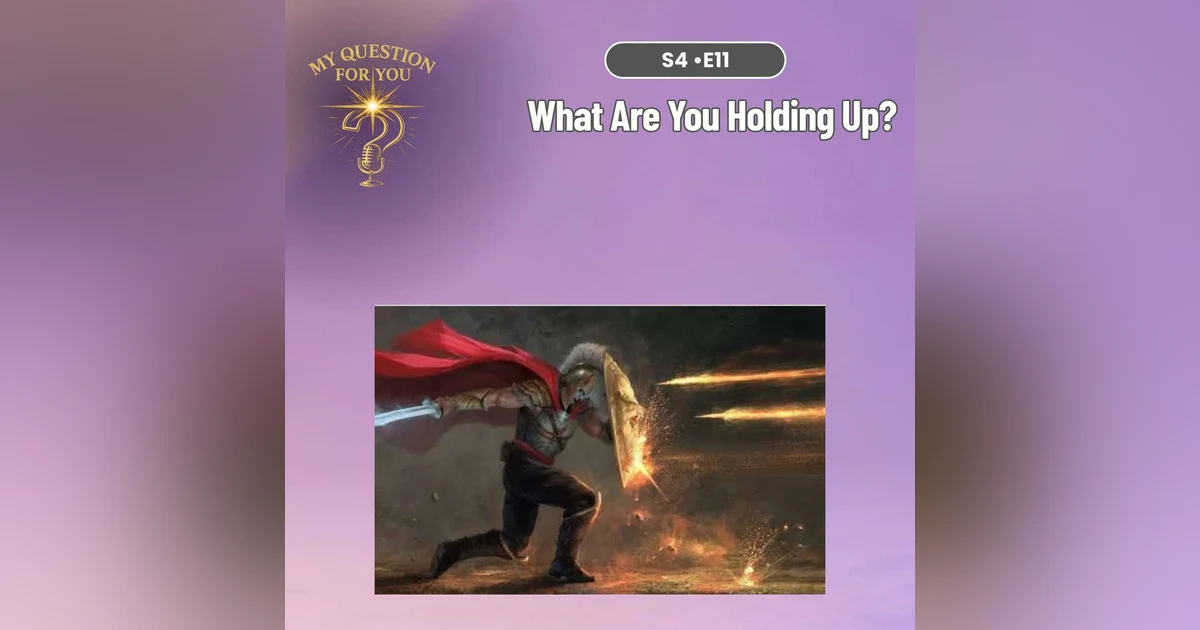


Season 4 of My Question for You: Wisdom for Your Walk continues with SUITED UP, our series taking a fresh look at the armor of God.
This week, we’re picking up the shield of faith.
At first, this may seem like the most obvious piece of armor. A shield protects you. Faith protects you. Got it.
But Paul doesn’t simply say the shield blocks the arrows.
He says it extinguishes them.
So why are the arrows on fire in the first place?
In this episode, we’re slowing down long enough to notice what that detail might teach us about faith, what we’re actually trusting when we raise the shield, and why getting hit isn’t the same thing as letting what hit you spread.
Because faith doesn’t mean nothing will ever come at you.
The arrow may hit the shield. It doesn’t have to set your life on fire.
So this week’s question is:
What are you holding up?
📖 Scripture: Ephesians 6:10–18; Romans 4:18–21
🎧 New episodes every week. Subscribe so you never miss a question.
If this one hit close to home, share it with someone who might need it too.
🔗 Take the next step at myquestionforyou.com — and join the free weekly email, A Quiet Invitation, for a short word of encouragement each week. Or just visit: https://preview.mailerlite.io/forms/1717098/165207819752047949/share
✨ Encouragement for your spirit. Wisdom for your walk.
You're under attack and something is going to hit you. Okay, I know. Great, great way to start an episode, right? But stay with me because Paul actually builds that reality right into the armor of God. By the time we get to the shield of faith, he doesn't describe a soldier standing somewhere safe, hoping nothing comes his way. There are arrows in the air. And Paul says they're on fire. So apparently, whatever this armor is preparing us for, the goal isn't to make sure nothing ever reaches us. And that got me looking at the shield of faith a little differently. Because honestly, the shield has always felt like the most obvious piece of the armor. It's a shield. You hold it up, it protects you, faith protects you. Okay, got it. Except that isn't quite what Paul says. He says the shield of faith can extinguish the flaming arrows of the evil one. Extinguish. That's different from simply blocking something, because an ordinary arrow can damage whatever it hits. But when the arrow is carrying fire, the danger isn't only the point of impact. The danger is what happens if the fire spreads. And suddenly this very familiar piece of armor gets a lot more interesting. The arrow may hit the shield, but it doesn't have to set your life on fire. Hey, I'm Melissa, and this is my question for you. We are continuing our series called Suit It Up, which is our series through the armor of God. And throughout this series, we've been trying to do something a little different. Most of us already know the pieces the belt of truth, the breastplate of righteousness, the shoes of the gospel of peace. And now Paul says, take up the shield of faith. So today, I want to spend our time talking about what a shield is. I want to look at what Paul says the shield actually does. And maybe by the time we're finished, faith will look a little different too. Ephesians chapter 6, verse 16 says, In addition to all this, take up the shield of faith, with which you can extinguish all the flaming arrows of the evil one. There's something about that verse that I think is easy to miss. The existence of a shield assumes there's something that you may need protection from. Paul doesn't present faith as a guarantee that the arrows stop coming. Actually, he seems to assume the opposite. And I think that matters because sometimes we can unintentionally turn faith into a formula. If I trust God enough, things should work out. If I'm walking closely with him, maybe certain things shouldn't happen. Or if I prayed about it and believed him, surely the outcome should look a certain way. But that's not the picture Paul gives us. The soldier has armor because he's standing in a battle. Faith doesn't remove that reality. Faith equips him to stand in it. And now we get to the part that I find really interesting. Paul could have stopped at arrows. That would have made perfect sense. A shield protects you from arrows. But he doesn't stop there. He calls them flaming arrows. And when I slowed down enough to picture that, I realized the fire changes the whole thing. Because now the danger isn't only when the arrow lands or when it hits, it's what the arrow could ignite. Something that hits one place has the potential to spread somewhere else. And spiritually, I think we understand that more than maybe we realize. Sometimes what happens to us and what that moment eventually becomes are two very different things. A disappointment can become distrust. Uncertainty can grow into fear. A question can slowly become a conclusion about God that He never gave us. The original thing may have landed in one place, but now the fire's spreading. And maybe that's why Paul doesn't say the shield simply stops the arrows. He says faith extinguishes them. It keeps what hits you from becoming something bigger than what actually hit you in the first place. That doesn't mean it didn't hurt. It doesn't mean you have to pretend that it didn't happen. And it certainly doesn't mean faith makes you untouched by life. It means the fire doesn't get to go everywhere. The arrow may have hit the shield, but it doesn't have to set your life on fire. But that raises another question. If faith is the shield, faith is what? Because we use that word pretty loosely. Have faith, keep the faith, just believe. Okay, believe what? This is where Abraham actually gives us something worth looking at. In Romans chapter 4, it talks about the promise God made to Abraham. And by the time we get to verse 18, what God had promised and what Abraham could see with his own eyes didn't really look like the same thing. Scripture doesn't pretend otherwise, because Abraham knew the reality of his circumstances. But Romans chapter 4, verses 20 and 21 say, yet he did not waver through unbelief regarding the promise of God, but was strengthened in his faith and gave glory to God, being fully persuaded that God had power to do what he had promised. That last part gets me. He was fully persuaded that God had power to do what he had promised. But Abraham's faith wasn't faith in faith. It wasn't confidence in his own ability to just believe hard enough. His confidence was in God. And I think that distinction's that distinction matters when we picture this shield, because faith isn't deciding what God is going to do and then convincing myself he's going to do it. There are plenty of situations where we simply don't know the outcome. Faith gives us something else to hold on to. Now that's a question worth sitting with because if my faith only works when I know the outcome, I don't have much of a shield. But if I've learned the character of the one I'm trusting, now I have something I can hold on to. And that brings us to one more detail in Paul's wording. He says, take up the shield of faith. So by now in this series, we've already put on the belt, we've put on the breastplate, our feet have been fitted. But Paul describes the shield as something we take up. There's action in that. At some point, what we believe about God has to become something we're willing to put between us and whatever is trying to tell us something different about God. That's where everything we've been putting on in this series starts to make sense together. Truth matters when something challenges it. Your peace matters when the ground doesn't feel steady anymore. And faith matters when something comes flying toward us and toward what we thought we believed. That's when the shield stops being a picture in Ephesians 6 and becomes something you understand a little differently. You take it up. Not because you know exactly what's going to happen next, you take it up because you've decided who you're going to trust while you're finding out what's going to happen next. So maybe the shield of faith isn't quite as obvious as it first seemed. Because Paul doesn't give us a picture of faith that keeps us from ever getting hit. He gives us faith that keeps the hit from becoming a fire. And there is a difference. Something can challenge what I believe without getting to rewrite what I believe. A hard season can raise questions without answering those questions for me. And I can stand in something I don't understand without deciding that God has suddenly become someone other than who He has always been. That's the shield. Not certainty about everything that comes our way, but confidence in the one standing with me when it comes. And maybe the next time you read Ephesians 6, you'll slow down when you get to verse 16. Because Paul could have simply told us that faith protects us, but instead he gave us this picture, an arrow, a flame, and a shield capable of putting the fire out. That's worth thinking about. Next week, Paul moves from the shield to the helmet of salvation. And there's already a question that I can't get away from. Why is salvation on your head? We've already talked about what protects the heart. So why does Paul connect salvation with the mind? I think we're going to have a lot of fun with that one. So I hope you'll come back and stay with us through this series. So here's my question for you. What are you holding up? Because faith isn't pretending the arrow isn't coming. And it isn't pretending the arrow doesn't hurt when it lands. It's knowing what you're going to trust when something challenges what you believe. Paul says God has given us a shield for that. Take it up. And remember, the arrow may hit the shield, but it doesn't have to set your life on fire. You can sign up at myquestion for you dot com, bringing you encouragement for your spirit and wisdom for your walk.