
What Would It Look Like to Stop Pretending?
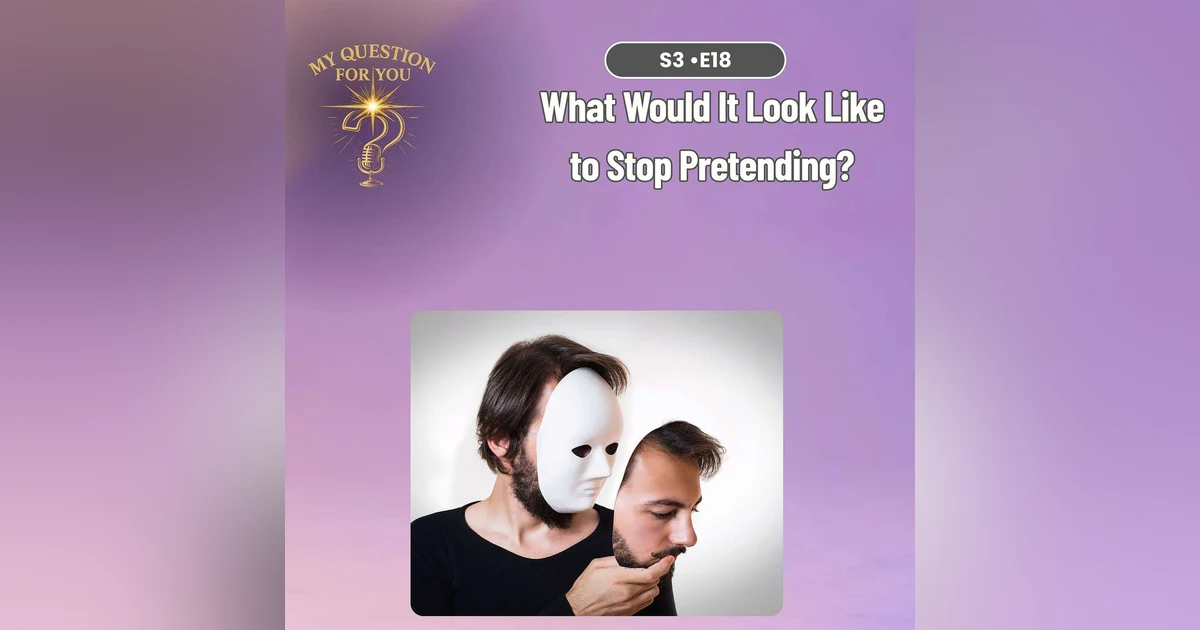


Work-You has it together. Small-Group-You has the right answers. 11 P.M.-You is a different story entirely.
We've spent this whole series asking what's underneath the smile — the fear of being seen, the doubt we don't say out loud, the ache of being surrounded by people and still feeling unknown. In this final episode, we bring it all together with the story of Naomi, a woman who lost everything and stopped pretending it was fine. She didn't perform peace she didn't have. She told the truth about her grief, out loud, by name — and it didn't push God away. It became the place where restoration actually started.
This episode asks the question the whole series has been building toward: what would it actually look like for you to stop pretending, even for a moment?
You don't have to pretend you're fine for the One who already knows you're not.
🎧 New episodes every week. Subscribe so you never miss a question.
If this one hit close to home, share it with someone who might need it too.
🔗 Take the next step at myquestionforyou.com — and join the free weekly email, A Quiet Invitation, for a short word of encouragement each week. Or just visit: https://preview.mailerlite.io/forms/1717098/165207819752047949/share
✨ Encouragement for your spirit. Wisdom for your walk.
I want you to think about the different versions of you that exist right now, depending on who's in the room. Maybe there's work you, capable, unbothered, on top of everything before anyone even has to ask twice. There's small group you. You're encouraging, steady, you've got a Bible verse ready. If anyone needs one, they know they can depend on you. Then there's family you, the one who has it together enough that no one even has to worry. They see, they know you're locked in, they know everything is good. Then maybe there's group chat you typing out the funny version of your week instead of the true one. One who's flashing all the emojis, you're smiling, you're hearting, you're liking. No one would know anything different. And then there's 11 p.m. you, the one who only shows up once the house goes quiet and no one else is watching. That one is usually the most honest version of you. And it's usually the one that no one else meets. Here's my question for you today. And it's the last one that we're going to sit with in this series. What would it look like to stop pretending, not to stop functioning, not to fall apart in front of everyone else, just to stop managing which version of you gets to exist depending on who's in the room? Hi, I'm Melissa, and this is my question for you. If you've been with me for this whole series, you know we've spent the last few weeks asking some really hard questions together. We asked things like, is anyone actually fine? What are you afraid people would see if they saw the real you? We talked about, are you even allowed to doubt God? And who sees you when no one else does? So today we bring it all home because underneath every one of those questions has been the same quiet truth. You don't have to pretend you're fine for the one who already knows you're not. Today I want to show you what it actually looks like when someone stops pretending. Not in theory, but in a real story with a real name that changed because of it. There's a story tucked away into the book of Ruth that starts with an ordinary decision most people wouldn't think twice about. There is a famine that hits Bethlehem. Food gets scarce, and a family has to make a call. They have to decide whether they are going to stay and struggle in their homeland or leave and dis and survive somewhere else. So a husband and wife pack up their two sons and they head to Moab. It's a neighboring country that's unfamiliar, and it's not exactly friendly territory for Israelites, but it's livable. It wasn't home, but it was survival. It was the best that they could decide to do at the time. And for a while it worked. They settled in, they got as comfortable as they could in a foreign land, a new land, and life went on. The husband's name was Elimelech. The wife was Naomi. And at the time, her name meant something like pleasant. Now, I want you to hold on to that detail for a second because it's gonna matter later. So hang on to that little part. So eventually, later on in the story, her husband died. Her sons grew up, they married Moabite women, and for about 10 years, there was a kind of fragile normal. Nothing was perfect, but it was working. So it wasn't the life that Naomi had planned, but it was a life. And then both of her sons died too. So now Naomi is left with nothing. She has no husband, no sons, no income, no protection. No place in a culture where a woman's security depended almost entirely on the men attached to her name. She only had two daughters-in-law and a famine that was finally lifting back in the land that she called home and the land that she came from. Things were finally starting to get a little bit better. So she decides to go home. Now, one of her daughter-in-laws decided to part ways with her. The other daughter-in-law, Ruth, refuses to leave her. And she says to her, Where you go, I will go. And so the two of them walk back to Bethlehem together. Now, Naomi isn't walking home with the life that she left with. She's walking home with grief that she hasn't had time to process, and a foreign daughter-in-law who's given up everything to come with her, and no idea what waits for her when she finally makes it back to her homeland. And when she finally arrives, the whole town notices. Scripture says it like this. Don't call me Naomi, she told them. Call me Mara, because the Almighty has made my life very bitter. I went away full, but the Lord has brought me back empty. Why call me Naomi? The Lord has afflicted me. The Almighty has brought misfortune upon me. I want you to catch something in that because it's easy to miss how bold that actually is. That's Ruth chapter 1, verses 19 through 21. So if you ever want to go back and sit with that a little bit more, that's where you can find her story. But here's what stands out when you slow down and picture it. The whole town is standing there. People she grew up with, people who knew her before all of this, before all of the grief, before they left. And they're asking, basically, is that really you? Now, she could have said yes and left it there. They had no idea what she had been through. She could have smiled, she could have given the short version that we talked about. She could have let them just assume whatever they wanted to assume. There was no way they knew everything that she had gone through, everything she had suffered through. So instead, she tells them to stop calling her by her own name. Pleasant isn't true anymore. So she asked them to call her bitter instead. This wasn't Naomi venting privately to God in a tent somewhere. This was Naomi standing at the gate of the town in front of the community she'd have to live among for the rest of her life, refusing to perform that everything was fine for people he could see right through it anyway. She wasn't hiding what the last decade had done to her. She named it out loud, in public, and on purpose. She was not afraid. And here's what I want you to notice. Nothing about that moment disqualified her from what came next. Because the story doesn't end at the gate, but it keeps going. Ruth goes out to gather leftover grain in the fields to keep them both fed. She ends up in the field of a man named Boaz, who was a relative of Naomi's late husband. Boaz notices her, he shows her kindness, and slowly a story of provision and redemption starts to unfold, one that eventually leads to Ruth remarrying to Boaz, having a son, and to Naomi holding that baby as her own. That baby's name was Obed. Obed's grandson was David. So the bitter widow standing at the gate, the one who told an entire town to stop calling her pleasant, ends up in the family line of a king. And centuries later, in the family line of Jesus. Naomi's honesty at the gate wasn't a detour from the story that God was writing, but it was the doorway into it. And I think a lot of us quietly believe that naming the true thing will cost us something. That if people saw what's actually behind the smile, we'd lose their respect or their comfort with us or our place in the room. But look at what actually happened to Naomi. She said the true hard thing in front of everyone, and the community didn't pull away from her. Instead, they stayed. Ruth stayed. Boaz noticed her, and life kept moving toward her, not away from her. Stopping the performance didn't end her story. It's what made the next chapter possible. So before we go any further, I want to give you something to actually hold on to after this episode ends, because a series finale should leave you with more than a feeling. It should leave you with something that you can come back to. Psalm 34, 18 says that the Lord is close to the brokenhearted and save those who are crushed in spirit. Say that back to yourself for a second. He's close. He's not far off. He's not disappointed or waiting for you to clean up before he comes near to you. But he is close to the brokenhearted. That's the same God Naomi was talking to at the town gate. And if it helps, write the reference down right now, Psalm 34, 18, so you can find it later on a day when saying, I'm fine, is the only thing you know how to say. But I want you to remember that God is close to you, that he cares about you, and he sees what you're going through. So take a second and just think back to that question that I asked you at the top of this episode. Which version of you gets to exist in which room? And what would it actually look like to let the true one out? Even if just for a little bit, even if you let your guard down just long enough to be real for a second. Maybe it's not standing at a town gate announcing it to everyone you know. Maybe it's just one person. We keep talking about that one trusted friend that you can turn to. One honest sentence instead of saying, I'm fine, one text that says what's actually going on instead of the version that's easier for everyone else to receive. You don't have to overhaul your whole life to stop pretending. Naomi didn't rebuild anything before she told the truth. She told the truth, and the rebuilding came after. So here's what I want you to do this week. And it's it's really pretty simple. Think of the answer you gave on autopilot. Think of when you said, I'm fine, or just busy, or I can't complain. And write down what you'd actually say if you told the truth instead. Not the crazy dramatic version, not a performance of pain either. Just the honest truth, the honest sentence. Maybe it sounds something like, you know what? Honestly, I'm tired in a way that sleep doesn't fix. Or I've been caring more than I've said out loud. Or maybe you just need to say, I don't think I'm okay, but I don't know what to do with that yet. Mental health is so important. Finding someone you can turn to is so important. And I want you to know if that person doesn't exist, if you don't think there's someone that you can be vulnerable enough with to just be honest, you can always take it to God. You can always write it down. You don't have to say it to anyone yet if that feels like it's too much. But let it exist somewhere outside your own head. That's where Naomi's honesty started too, with words that were finally allowed to just be true, words that she could just say and admit. Over this series, we've asked if anyone's actually fine. We've asked what we're afraid people would see if we stopped hiding who we really are. And we've asked if it's even allowed to doubt God in the middle of it all. We've asked who sees us when no one else does. And today, we land on the question underneath all of those earlier questions that we've walked through. What would it look like to stop pretending? Here's what I hope you carry with you, not just from today, but from this whole series. You don't have to pretend you're fine for the one who already knows you're not. He already knows what's behind your smile. He knew before you said a word, and he's not waiting for the polished version of you to show up before he starts writing something good about your story. Naomi walked into Bethlehem bitter and empty, and within that same story, God was already preparing the field, the provision, and the family line that would carry hope for generations to come. Your honest moment isn't the end of your story either. In fact, it might be exactly where the next chapter starts. You were never asked to perform your way through this series. Not the fine, not the strong, not the put-together version, just the true one. The one that gets tired, the one that doubts sometimes, and the one that feels unseen more often than it would ever say out loud. That's the one God's been close to you the whole time. That version of you, the honest version of you. So wherever you are right now, if you're in your car, wherever you're listening to this, or maybe you're you'll find yourself thinking about it late at night when you're lying in bed before you fall asleep. Let this be the moment that you stop managing which version of you gets to show up. You don't have to pretend you're fine. God already knows and sees who you are and what you're going through. He knew before this series started, and he'll know long after it ends what you're facing, what your struggle is, what you're hiding. So I really hope somewhere through these past five weeks through this message, you've found a little hope, a little encouragement, what you need to stop pretending, to get honest, to find that person you can open up to, or even just to find the courage and the strength to write it down. Just take it to God. Get it out of your head and get honest with it and find a way to move forward. That closes out this series. And until next time, I really hope that you will keep asking, keep listening, and remember, the truest thing you can bring to God is whatever is actually true, not the version you think He wants to hear. Before you go, if today's question stayed with you, I'd love to keep the conversation going. Each week, I send a short email called This Week's Question A Quiet Invitation, and it's a simple reflection to help you stay grounded, to pay attention, to dive deeper into God's Word, and to walk with God throughout your week. You can sign up at myquestion for you dot com, bringing you encouragement for your spirit and wisdom for your walk.