
What’s Protecting Your Mind?
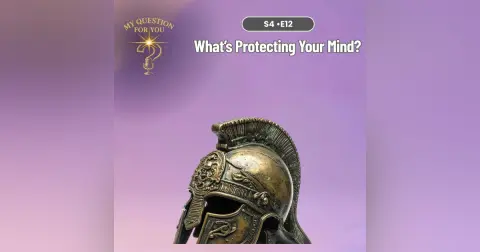


Season 4 of My Question for You continues with SUITED UP, our series taking a fresh look at the armor of God.
This week, we’re putting on the helmet of salvation.
And the question seems simple:
Why does salvation go on your head?
Paul doesn’t explain the helmet in Ephesians 6. But in another letter, he gives us an interesting clue—calling it “the hope of salvation.”
So what does hope have to do with protecting our minds?
In this episode, we’re looking at salvation as more than something that happened when we first believed. It also reminds us that God is still at work, His story isn’t finished, and what we see right now isn’t all there is.
Maybe that’s why hope makes such good armor.
Because sometimes we need to remember that where we are right now is not where the story ends.
So this week’s question is:
What’s protecting your mind?
📖 Scripture: Ephesians 6:10–18; 1 Thessalonians 5:8–11; Romans 8:22–25
✨ Encouragement for your spirit. Wisdom for your walk.
🎧 New episodes every week. Subscribe so you never miss a question.
If this one hit close to home, share it with someone who might need it too.
🔗 Take the next step at myquestionforyou.com — and join the free weekly email, A Quiet Invitation, for a short word of encouragement each week. Or just visit: https://preview.mailerlite.io/forms/1717098/165207819752047949/share
✨ Encouragement for your spirit. Wisdom for your walk.
Okay, why does salvation go on your head? That's the question we're sitting with this week. We're almost all the way through the armor of God now. And when Paul gets to the helmet, he says, take the helmet of salvation. And I don't know that I've ever really questioned that. Helmets protect your head, salvation protects your mind. It all makes sense. But what does that actually mean? Because salvation feels like it could have gone somewhere else. We talk about giving our hearts to Jesus. We talk about being forgiven, being made new, being saved from sin. So why does Paul take salvation and put it over the soldier's head? Well, there's another place in the Bible where Paul uses almost the same picture, except there he adds one word. And that one word helped this make a lot more sense for me. He calls it the hope of salvation. And I think that may tell us something about what this helmet is really protecting. Because sometimes what we need most is a reminder that where we are right now is not where the story ends. Hey guys, I'm Melissa, and this is My Question for You. We're continuing Suit It Up, which is our series through the Armor of God. We've made it to the helmet of salvation. And rather than just saying the helmet protects your thoughts, I want to stay with Paul's choice of words. Why salvation? Why the head? And what does hope have to do with either one? Let's start in Ephesians chapter six, verse seventeen. Paul simply says, Take the helmet of salvation. That's it. He doesn't explain the helmet in that verse. But over in First Thessalonians chapter five, verse eight, Paul uses the same image again. This time he says putting on faith and love as a breastplate and the hope of salvation as a helmet. The hope of salvation. Okay, now we have something to work with. Because hope points us towards something ahead. And that can sound a little strange at first, but if I belong to Christ, aren't I already saved? The answer is yes. But the Bible talks about salvation as something God has already accomplished through Jesus and something that is still moving toward its full completion. Romans 8 talks about that. Paul describes a world that is broken. Creation is groaning, it's crying out for more. And we are still waiting for the day when everything God has promised is finally complete. That's something that we're still yearning for and striving for and waiting for today. So being saved doesn't mean we're already living at the end of the story because we're not. We still live here in today, in this world, and we still experience a world where things aren't the way God ultimately intends them to be. So here's the difference. We know this isn't the ending. And maybe that's why hope makes such a good helmet. Because right now, everything that's happening in our lives today can be loud, it can be distracting, and it can be consuming. Whatever is happening in front of us tends to take up a lot of space in our life and in our minds. And if we're not careful, right now can start feeling like forever. That's where I think this helmet becomes incredibly practical without us having to make it complicated. The helmet of salvation reminds me this is not the whole story. Not this doesn't matter or this isn't hard. Not even this is going to turn out the way I want. Just this is not the whole story. Because salvation tells me that God has already done something through Jesus that cannot be undone by what I'm going through today. And it tells me he's taking his people somewhere. Sin doesn't get the final word. Brokenness and death don't get the final word. God does. So whatever chapter and mess and drama that I might be standing in right now, I don't have to mistake it for the ending. And that's what hope is all about. It gives us something to look forward to, to believe in. And Paul says to put it on your head. Now, helmet makes a little more sense when you start thinking about it that way. Because I used to hear helmet of salvation and mainly think, remember that you're saved. That's what I would think of whenever I read through the armor of God and came to the helmet. That's kind of how I pictured it, as thinking about being saved. And I'm not saying that's necessarily wrong, but Paul's words in 1 Thessalonians give the picture a little more depth. It helped me think about it and see it a little differently. So, yes, remember what Jesus has already done for you, but also remember where his salvation is taking you. There is something ahead, something waiting for us. There's something more. And knowing that changes the way you look at what's happening now. Think about reading a book when you already know how it ends. You still experience the tension in the middle. You still care about what's happening, but you read those pages differently because you know this isn't where the story stops. You know there's more to it. So I think there's something similar happening with the helmet. But God hasn't told us every detail of what will happen between here and the ending. But He has told us enough about the ending to give us hope in the middle. And that hope protects something. It keeps the middle from convincing us that there is nothing more to be hopeful for, optimistic for, that there's nothing beyond the now. And there's another thing that I like about this picture. A helmet doesn't keep a soldier from seeing the battlefield. He can still see what's happening around him. So putting on the helmet of salvation doesn't mean looking away from reality. But actually, Christian hope allows us to look at reality pretty pretty clearly. Paul certainly did. He knew suffering and he knew loss. He knew what it meant to follow Jesus when doing so cost him something. But none of those things convinced him that God had lost control of the story. And that's very different from optimism. Because optimism says, I think this is going to get better. Hope says, whatever happens here, I know this isn't the end. And that's so much stronger than just optimism. Because optimism depends on what I think might happen. Hope depends on what God has already promised. So now I start to understand why Paul calls hope armor. And maybe we've put maybe we've made putting on the helmet more complicated than it needs to be. Paul isn't asking us to manufacture hope, to conjure up hope that we really can't be anchored to. He's telling us to put on something God has already given us, and that's salvation. Remember what Jesus has done for us. Remember what his resurrection means. And remember that God isn't finished. And remember that the piece of the story you can see right now is exactly that. It's just the piece of the story. It's a small piece of the bigger picture. And I think that's really important in a series about spiritual warfare. Because one of the easiest ways to lose perspective is to start believing that whatever you're facing right now is bigger than everything God has already said about your future, about who you are, and about the plans that He has for you. So the helmet brings the bigger story back into view, back into perspective. Where I am is not where the story ends. So now when I go back to Ephesians 6 and read, take the helmet of salvation, I start to hear it a little differently. I don't just picture protection around the head. I hear a reminder. I hear, don't forget where this is going. You belong to Christ. He has saved you and he is still at work. And there is a day coming when the brokenness we know now will not be the reality we live in anymore. That's not ignoring what's happening today. It's refusing to let today tell you that today is all there is to our story. And maybe that's what hope does for our minds. It keeps us from confusing the middle of the story with the end. Next week, we have one more piece of armor left, and that's the sword of the spirit. Paul actually tells us exactly what it is. He says, it is the word of God. So that one should be easy enough to follow, right? Well, knowing what the sword is and knowing how to use it may be two very different things. That's where we're headed next week, and that's how we're going to close out this series. So I really hope you'll come back and help us finish this one out. So here's my question for you. What's protecting your mind? Because now I think I understand Paul's helmet a little better. Salvation doesn't only tell me what Jesus has already saved me from, it gives me hope for what he's ultimately bringing me to. And that means whatever I'm standing in today doesn't get to call itself the ending because it's not. God has already told us there's more. Until next time, I hope that you'll keep asking, keep listening, and remember, don't confuse where you are with where God says you're going. You can sign up at myquestion for you dot com, bringing you encouragement for your spirit and wisdom for your walk.